
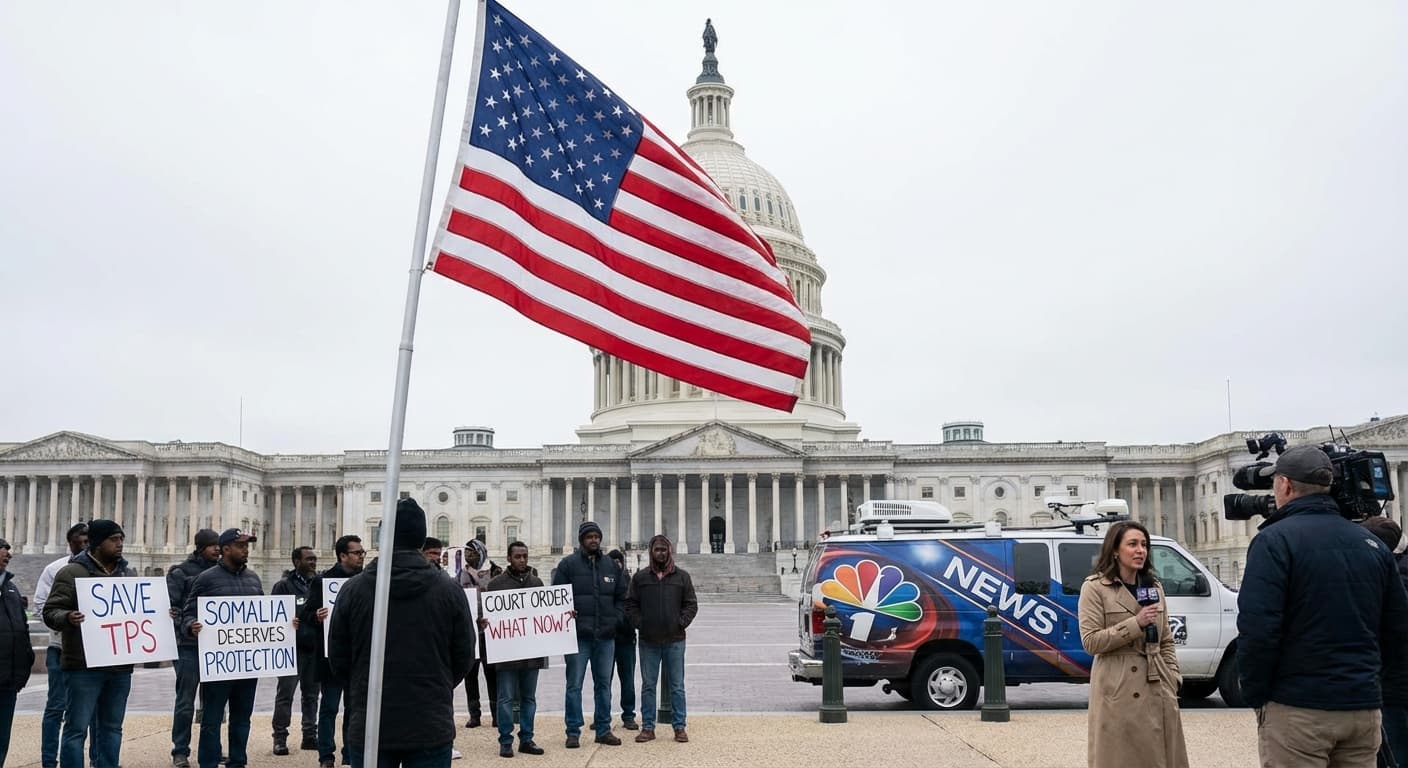
On January 13, 2026,
Secretary of Homeland Security Kristi Noem announced the termination of Somalia's designation for Temporary Protected Status (TPS).
The termination was set to become effective on March 17, 2026
, following the publication of a Federal Register notice on January 14 and a 60-day wind-down period. But in a dramatic eleventh-hour development, a federal judge intervened — casting the fate of more than a thousand Somali nationals into legal limbo.
The Termination Decision
After reviewing country conditions and consulting with the appropriate U.S. government agencies, Secretary Noem determined conditions in Somalia no longer support its designation for TPS and that it is contrary to the national interest to permit Somali nationals to remain temporarily in the United States.
In her statement announcing the decision, Secretary Noem declared:
"Temporary means temporary. Country conditions in Somalia have improved to the point that it no longer meets the law's requirement for Temporary Protected Status."
DHS's decision was grounded in what it characterized as a comprehensive assessment of national interest factors including public safety, national security, immigration integrity, and foreign policy, as well as an analysis of the nature of the violence in the country. The agency argued that the significant change in armed conflict from the initial designation of TPS for Somalia in September 1991 to the present shows that violence no longer constitutes an ongoing armed conflict nor does it fully prohibit Somali nationals from returning in safety.
DHS estimated that there are 1,082 current approved beneficiaries under the designation of Somalia.
Last-Minute Legal Challenge
The termination did not go unchallenged.
African Communities Together (ACT), Partnership for the Advancement of New Americans (PANA), three Somali TPS holders, and one Somali TPS applicant filed a federal lawsuit in the District of Massachusetts challenging the Trump administration's periodic review and resulting termination of TPS for Somalia.
The lawsuit sought postponement of the March 17, 2026, effective date of the termination, which the plaintiffs argued threatens thousands of Somalis and their families who have built lives in the United States while their home country continues to face unsafe conditions, including devastating armed conflict, widespread displacement, and an acute humanitarian crisis.
Then, on March 13 — just days before the termination date —
a federal District Court judge in the District of Massachusetts granted advocates' request for an interim stay of the impending termination.
The court's March 13 order temporarily delays TPS termination beyond the scheduled March 17 expiration date in order to preserve the status quo while the court considers the merits of the case.
Somalia TPS beneficiaries remain eligible for work authorization and protection from removal during the period of the temporary stay.
The pause of the termination of Somalia's TPS will remain in effect temporarily, pending further court order.
However,
the Trump administration is likely to seek a reversal of the stay
, and the situation remains fluid.
As of the time of the court's order, USCIS had not yet updated its Somalia TPS webpage to reflect the court decision.
Part of a Broader Campaign
Somalia's TPS termination is far from an isolated action. The administration has systematically moved to end TPS designations across multiple countries.
Since taking office, the current administration has consistently moved to terminate TPS designations as they approach existing expiration dates.
Already in the pipeline:
On February 13, 2026, Secretary Noem published a notice terminating TPS for Yemen.
This termination is effective May 4, 2026.
Secretary Noem determined that conditions in Yemen no longer meet the statutory requirements for TPS and that it is contrary to the national interest to permit Yemeni nationals to remain temporarily in the United States.
The list of already-attempted terminations extends further.
Secretary Noem also determined that Haiti no longer met the conditions for its TPS designation.
Haiti's TPS designation and related benefits were slated to terminate on February 3, 2026. However, on February 2, 2026, a single judge in the U.S. District Court for the District of Columbia issued an order staying the Secretary's TPS termination decision.
Ethiopia's TPS designation and related benefits were slated to terminate on February 13, 2026. However, on January 30, 2026, a single judge in the U.S. District of Massachusetts stayed the Secretary's TPS termination decision.
South Sudan's TPS designation and related benefits were slated to terminate on January 5, 2026. However, on December 30, 2025, a single judge in the District of Massachusetts issued an order staying the South Sudan TPS termination.
Each termination has faced legal challenges in court
, creating a patchwork of competing judicial orders and government actions.
What This Means for Affected Individuals
The practical consequences for Somali TPS holders remain significant, particularly given the legal uncertainty surrounding the court's temporary stay.
TPS is a humanitarian program that allows eligible nationals from designated countries to live and work in the United States for a limited period when conditions in their home country prevent safe return. TPS does not lead to permanent resident status but provides protection from deportation and affords employment authorization while the designation is in effect.
If the termination ultimately takes effect,
Somali TPS holders will no longer have legal permission to stay in the U.S. They revert to the status they had prior to TPS (typically, none). Without another status, they become "unauthorized" immigrants and could be subject to detention and removal.
Once TPS protection ends, a TPS holder will revert back to their previous immigration status. For those without legal status in the U.S., they will return to an undocumented status and potentially be subject to removal proceedings.
For employers,
employers must reverify TPS Somalia beneficiaries who presented these EADs before they start work on March 18, 2026
— though the court stay may alter this timeline. Employers should closely monitor developments.
For beneficiaries exploring alternatives,
being granted and maintaining TPS until a reasonable period before the filing of an asylum application is considered an extraordinary circumstance for the purposes of the one-year filing deadline. In other words, having TPS "stops the clock" on the requirement to file for asylum within one year of arriving in the United States.
This is a critical consideration for those who may have asylum claims.
Yemen: The Next Termination on the Horizon
Yemeni TPS holders face their own approaching deadline.
Secretary Noem will not extend the TPS designation for Yemen, scheduled to expire March 3, 2026, but beneficiaries will be granted a 60-day transition period, through May 4, 2026.
After May 4, Yemeni nationals without other lawful status will be subject to removal.
Employers must reverify TPS Yemen beneficiaries who presented these EADs before they start work on May 5, 2026.
What to Do Now
Given the rapidly evolving legal landscape, affected individuals should take the following steps:
1. Stay informed. The court stay for Somalia is temporary and could be reversed. Monitor USCIS and court developments closely.
2. Consult an immigration attorney immediately.
Only an attorney or an accredited representative working for a Department of Justice (DOJ) recognized organization can give you legal advice.
3. Explore alternative immigration pathways. Options may include asylum applications, family-based petitions, employment-based visas, or other forms of humanitarian relief.
4. Beware of scams.
Some unauthorized practitioners may try to take advantage of you by claiming they can file TPS forms. These same individuals may ask that you pay them to obtain such forms; however, all USCIS forms are free for download from the USCIS website.
The Somalia TPS saga — and the broader wave of TPS terminations — underscores the precarious nature of temporary immigration protections and the urgency of proactive legal planning. Whether the federal courts will ultimately allow these terminations to proceed remains one of the most consequential unresolved questions in U.S. immigration law today.
---
This article is for informational purposes only and does not constitute legal advice. If you are affected by the termination of TPS for Somalia, Yemen, or any other country, please contact a qualified immigration attorney for guidance specific to your situation.